Treating injuries is a $163 billion problem in the US. Leaving aside the enormous and largely neglected opportunity to reduce costs by avoiding injuries in the first place (e.g., injury prevention programs), are there any other aspects of trauma care that could be rendered more efficient? That is a question Craig Newgard and colleagues set out to explore in their study, published in the September 2013 issue of Health Affairs, The Cost of Overtriage: More Than One-Third of Low-Risk Injured P
Treating injuries is a $163 billion problem in the US. Leaving aside the enormous and largely neglected opportunity to reduce costs by avoiding injuries in the first place (e.g., injury prevention programs), are there any other aspects of trauma care that could be rendered more efficient? That is a question Craig Newgard and colleagues set out to explore in their study, published in the September 2013 issue of Health Affairs, The Cost of Overtriage: More Than One-Third of Low-Risk Injured Patients Were Taken to Major Trauma Centers. Health Affairs, 32(9)2013.
The researchers looked at data for injured patients transported by 94 EMS agencies in seven different regions to 122 hospitals. The study required obtaining IRB approval from sixteen different Institutional Review Boards – no small feat. During the three years of the study, 1/1/2006-12/31/2008 [why so long to get this published?], 301,214 injured patients were transported to a hospital. Forty-two percent of the time the hospital was a Level 1 or Level 2 trauma center.
The characteristics of the study population were interesting. Fifty-four percent of the injured people were 18-54 and another 34% were 55 or older and and falls were the leading mechanism of injury (39.5% of the total) with motor vehicle crashes coming in at second at 30%. Eighty-five percent of the patients were classified, using the Injury Severity Score, as having minor injuries and another 10.4% as having moderate injuries (288,832 people).
Since EMTs must rely on findings they observe in the field a more relevant assessment of how seriously injured a person is, for triage purposes, is the calculation of the field trauma activation score based on national field triage guidelines. 248,342 of the patients were identified as low-risk. Despite that one-third of them were transported to a major trauma center.
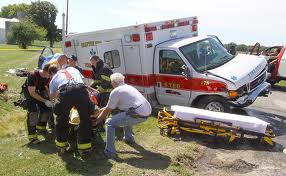
Photo from chronicle.northcoastnow.com
The average adjusted cost of care (details of the adjustment are available in an online appendix to the article) was $5,590 higher at a Level 1 trauma centers compared to a non-trauma hospitals. Honing in on those with minor injuries, they researchers found that treatment at Level 1 centers was $4833 higher than at a nontrauma center.
The authors correctly avoided saying exactly why costs are so much higher in trauma centers (staffing? cost-shifting to pay for uncompensated care?) and they did not determine the exact reason(s) why the overtriage to major trauma centers took place (patient choice and convenience are amongst the factors). Rather they just point out that 40% of acute care costs ($136,718,910) could be saved if all minor injuries were transported to non-trauma rather than trauma hospitals.
But can we really get there? Could nontrauma hospitals handle the volume? Would patients accept being transported to their second choice hospital? Would outcomes be as good? Would it be worth the effort? It is hard to know without further analysis and perhaps a pilot, but it seems to me we must explore all avenues of waste in healthcare if we are to tame the cost monster. The authors are to be applauded for adding this potential cost saver to mix.