

.jpg)
When I heard about Siemens Healthcare’s new products for angiography — aiding in diagnosis and therapy of diseases such as coronary heart disease, stroke and cancer — I was intrigued by the product names: Artis Q and Artis Q.zen. So I wandered into one of the endless exhibition halls here at RSNA 2012 to the Siemens booth, if booth is the right word for an exhibit that merits its own Zipcode.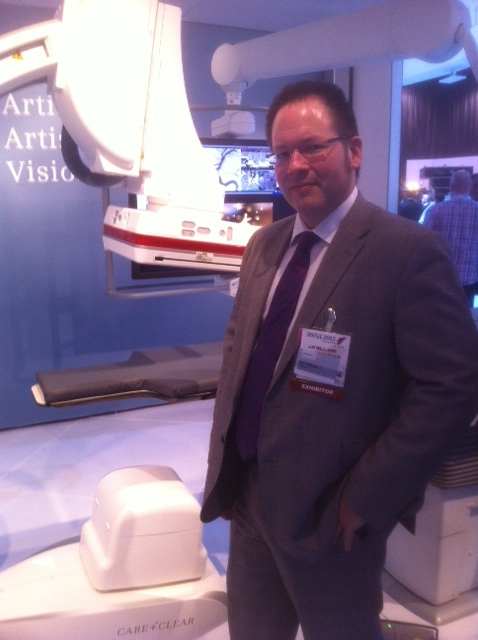
When I heard about Siemens Healthcare’s new products for angiography — aiding in diagnosis and therapy of diseases such as coronary heart disease, stroke and cancer — I was intrigued by the product names: Artis Q and Artis Q.zen. So I wandered into one of the endless exhibition halls here at RSNA 2012 to the Siemens booth, if booth is the right word for an exhibit that merits its own Zipcode.
Dr. James Williams is the amiable and smart vice-president of marketing for angiography and interventional X-ray systems. Jim walked me through the nuances of the products and I asked him about the appendage to the Q. “The zen concept is peace and quietness and calm,” he said. “So this refers to a new detector technology in the Artis Q.zen that substantially reduces background electronic noise, so it’s peaceful and quiet.”
Jim also described how the new technology allows for better imaging while lowering the radiation dose. “To create a more dose-effective system, in other words,” he explained. Two hardware components are vital for angiographic image quality: the X-ray tube and the detector. The X-rays emitted by the tube pass through the patient and hit the detector, which converts them to image signals.
The emitter lies at the heart of the X-ray tube and typically it has been like a coiled filament found in an old-school light bulb. The more heat an emitter can withstand, the better it can perform by providing more power and smaller focal spots. But if it gets too hot, it melts! In these products, Siemens has produced the first flat emitter made of tungsten — thicker than conventional filaments — which can handle higher temperatures to provide high power for short pulses. Flat emitters have been found to provide up to 70 percent increased visibility of small vessels compared to previous tube technology.
Now the zen. The Artis Q.zen series combines this new flat emitter with a detector technology that permits detection at ultra-low radiation levels. Siemens asserts that it can use doses as low as half the usual levels normally applied in angiography. Several innovations revolutionized detector technology. Until now, almost all detectors have been based on amorphous silicon wafers, which are irregular in structure and can contribute to electronic noise. The new detector uses crystalline silicon wafers, which are uniform in structure and allow higher circuit density. The higher circuit density is the key to significantly reducing electronic noise and this, in turn, enables ultra-low-dose imaging.
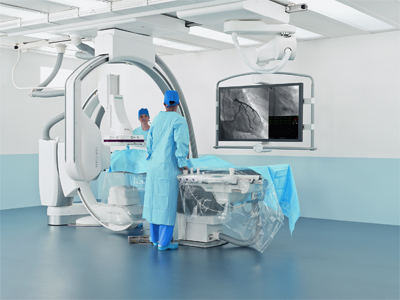
figure 1: Siemens Healthcare has developed a revolutionary new X-ray tube and detector technology for its Artis Q and Artis Q.zen angiography systems to improve minimally invasive therapy of diseases such as coronary artery disease, stroke and cancer.
In addition to the new hardware, Siemens has introduced several software applications that improve interventional imaging. Jim showed me some imaging in coronary artery disease treatment. The applications allow precise correlation of angiography images with ultrasound images taken by a probe inside the coronary arteries. I could see that stents can be imaged in real time during therapy, with motion stabilization created by simultaneous correction for the heartbeat.
“The benefit to the patient is that we’ve done everything possible to allow the clinician to bring the dose down to a lower level than ever before,” said Jim. “In addition to that, our software applications allow precise stent placement and see the exact conditions inside the arteries.”
Peace. Quietness. Calm. And better therapy through angiography.






.jpg &description=The+Zen+of+Angiography)