 Imagine what would happen if scientists from around the world could wrap their collective brains around a global health challenge. This is the premise of Scientists without Borders (SWB), an initiative that provides a free web-based platform that allows scientist from around the world to come together to tackle urgent global health needs.
SWB is a public-private partnership that was conceived of by the New York Academy of Sciences in conjunction with the United Nations’ Millennium Project. The Executive Director is an attorney, Shaifuli Puri, with significant operational experience. The Chair is Ellis Rubinstein, President and Chief Executive Officer or The New York Academy of Sciences. There is an impressive list of Advisors from around the world.
Shaifuli Puri described one of the major initiatives of SWB in an article titled, “Crowdsourcing for Health” published in the Spring 2012 issue of The New York Academy of Science Magazine. In collaboration with the Bill & Melinda Gates Foundation and The Sackler Institute, SWB has launched an effort to fill in the gaps in existing knowledge about “essential processes and biological mechanisms related to healthy fetal growth and nutrition for infants and children.” This project brought together “hundreds of diverse participants among the human nutrition, animal science, and veterinary science communities” via an invitation only crowdsourcing platform, to engage in discussions about what knowledge is needed to advance these fields. The idea was to let their imaginations run wild so that “significant and disruptive advances” would be generated.
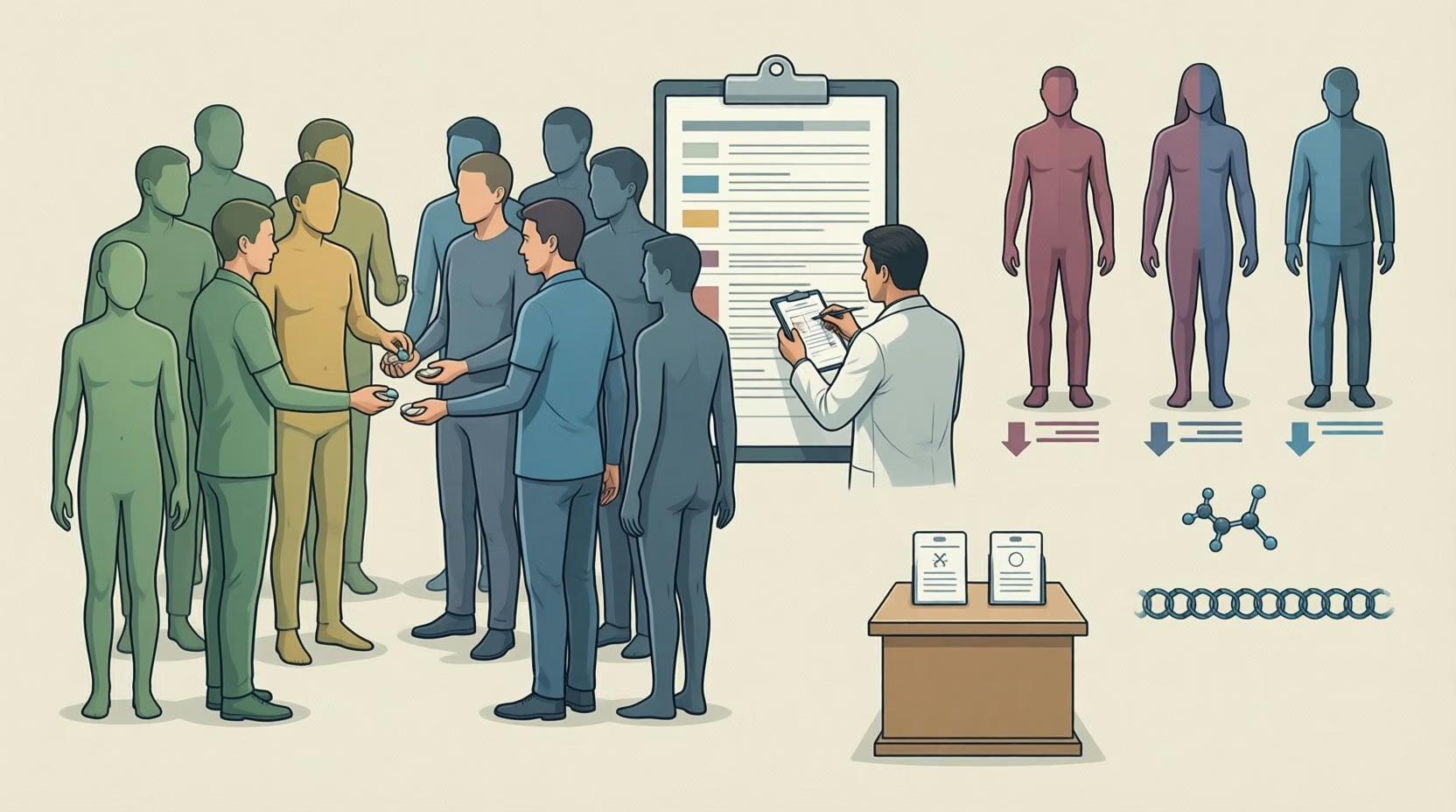
Participants were encouraged to engage in discussions in seven areas: biomarkers and metabolomics, nutrition and epigenetics, vaccine and immunology, animal models, biofortification and dietary change. Participants rated each others contributions awarding points for innovation, feasibility and expertise. The crowdsourcing activity is planned to last for 45 days. Afterwards a small group of leaders from academia, policy, multinationals, and funding entities will convene to “discuss and build on the most promising ideas” that can then be translated into actionable steps. Eventually, the crowdsourcing platform will be open to the public.
I love that NYAS is doing this, but having an invitation-only platform with instructions to focus on seven predefined topics followed by a small closed meeting of select leaders is not, in my mind, true crowdsourcing. Foldit, a website where people from all walks of life from all over the world come together to “solve puzzles for science” has demonstrated successfully that you don’t have to have a PhD or MD or be a recognized leader in your field in order to make significant contributions to a scientific challenge. It may be the lab tech, not the lab’s director, who is the person who makes the breakthrough:
And, although I love the idea of Scientists without Borders, I was sorely disappointed after spending some time on their website. When I tried to login I got a warning that the login wasn’t safe and may have been highjacked! When I perused the challenges that were posted, most were old and showed no signs of recent activity. And when I looked at the “Groups” page, the only things listed were a bunch of promos for iPhone cases.
What I have learned from my recent foray into crowdsourcing seed money for health tech entrepreneurs is that it is hard work. You can’t just throw up a website and expect that all projects will go viral. You need to keep safe from the folks who like to mess around with website for their own gain and you need to keep the content current. You also need to help challenge proposers to promote their ideas and drive traffic to their projects. Come on, NYAS, I know you can do better. This is a great idea, but seemingly poor execution.