Eyeforpharma recently published a report called “True Value Telehealth” that gives good insights into the current and future market of telehealth and telecare. I made a summary of the most valuable points of this report. Go to the link below for the full report.
Eyeforpharma recently published a report called “True Value Telehealth” that gives good insights into the current and future market of telehealth and telecare. I made a summary of the most valuable points of this report. Go to the link below for the full report.
Market now and for the future
Research firm InMedica predicts that the American telehealth market will grow by 600 percent between 2012 and 2017. This would represent an increase from the current 227,000 telehealth patients to reach up to 1.3m patients in 2017. They think this is mostly related to the reimbursement changes in the US.
In Europe, telehealth adoption is expected to gather pace as more governments seek innovative ways to manage budgetary pressures, amidst ongoing economic difficulties. According to a report by Deloitte, ‘Primary Care: Working differently: telecare and telehealth – a game changer for health and social care’ estimated spending on telehealth in Europe is 170 m€ in 2010. This figure is expected to increase to 353 m€ in 2015.
The diagram below shows the market share of telehealth and telecare in Europe. It is interesting to see that the UK has the biggest market share.
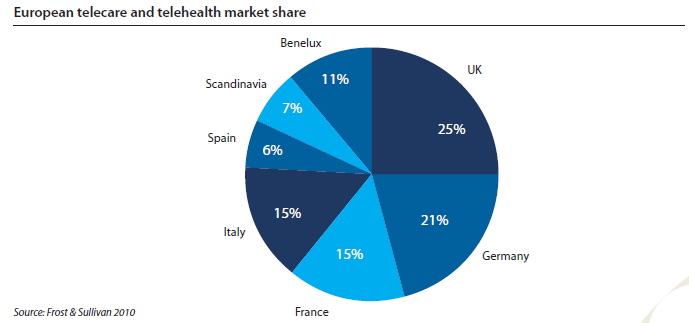
Market share telehealth europe
Developing markets
The developing countries are really emerging. This is because these countries are masters of maximizing resources. Take a diabetes management telehealth program as example: while the project uses relatively basic technology (SMS), it’s expected to have a huge impact on patients. Applications include reminders about diet, well-being, medicines, appointments and getting their prescriptions filled. The project has its limitations, but it will have an impact and it’s obviously really simple and low-cost to develop. So what we learn of this is that it doesn’t have to be complex and it doesn’t have to be expensive.
Why telemedicine works
Jon Linkous, CEO of the American Telemedicine Association, gives a clear message about the most important driver of telehealth. ‘Number one – telemedicine saves lives.’ Beyond this, Linkous notes, ‘it facilitates independent lifestyles, keeps people in their own homes in their own communities, it improves the quality of their care and it makes it a lot more convenient for the patient.’
Garth Sutherland, the CEO of Nexus6 a private company that provides electronic remote monitoring devices for inhaled drug delivery, also sees a major role for telehealth in helping to boost adherence. As an example, for newly diagnosed patients, he notes that, ‘it’s very important to establish great adherence to therapy very quickly.’ To enable this, ‘it requires a real-time system because it’s important that patient behaviors are driven towards adherence on a very timely basis. Following hospital admission, adherence drops from between 75-95% on the day after discharge to less than 50% after 10 days.’ I suggest to implement a medication adherence support system!
Costs, the biggest problem
One of the most common objections to adopt telehealth is cost. A World Health Organization survey found that the perception of costs for telehealth being too high is the greatest barrier for increased adoption of programs. However, cost concerns are most important in developing nations, where initial funding challenges must be overcome. In western countries, the debate centers on the cost-effectiveness of telehealth programs.
Interoperability
Rick Kates, who is the CEO of Viterion TeleHealthcare, also champions the importance of effective data integration. Key is, he says, to ensure that physicians are not ‘overwhelmed’ with the information.’ This can be achieved by understanding that they ‘don’t need more information, just better information.’ Kates also notes that interoperability of telehealth systems is essential. ‘Healthcare professionals and payers don’t want to be looking at multiple user interfaces and have to worry about whether or not certain data is going to come across and how it’s going to come across.’
Source: Eyeforpharma